
Content operations have become far more demanding than they were just a few years ago. Businesses are no longer publishing only to a single website or updating a small set of landing pages. Today, content must support websites, apps, ecommerce experiences, customer portals, support centers, internal tools, and campaign journeys that all need timely and consistent information. As content volume grows, so does the operational pressure on teams. They must create assets faster, maintain accuracy across channels, keep metadata clean, update outdated materials, and support stronger personalization and reporting without allowing the system to become chaotic.
This is why automation is becoming such an important part of modern content strategy. Yet automation only works well when the content system itself is flexible enough to support it. A headless CMS provides that flexibility by separating content from presentation and storing it as structured, reusable data. That structure makes it easier for AI to work with content at the field, component, and model level rather than being forced to operate on rigid page templates or disconnected publishing environments. Instead of only helping with one step of the process, AI can support multiple parts of the workflow at once, from content creation and classification to delivery, optimization, and governance.
When AI and headless CMS are combined effectively, content workflows become faster, more scalable, and more intelligent. Teams can reduce repetitive manual work, improve consistency, respond more quickly to business needs, and focus more of their time on strategy and quality. AI does not replace content teams. It changes what they spend their energy on. In a headless CMS environment, this can have a major impact on how content is planned, managed, and delivered across the business.
Why Content Workflows Have Become More Complex
Content workflows have become more complex because digital content now has to serve many more purposes than before. A single piece of content may need to support awareness, conversion, onboarding, retention, support, and internal alignment depending on where and how it is used. It may appear on a website, in an app, in email, in search results, or inside a support flow, all while needing to stay accurate and aligned with brand standards. This puts pressure on teams because the work is no longer limited to writing and publishing. It includes modeling, tagging, updating, reviewing, repurposing, translating, measuring, and distributing content across many touchpoints. This is also where the benefits of using headless CMS for content management become more visible, since a more flexible content structure can help teams handle complexity more efficiently across channels.
This complexity often creates bottlenecks. Teams spend time copying information between systems, manually updating metadata, chasing approvals, checking for inconsistencies, or rebuilding similar assets for different channels. Even when organizations have talented editorial and marketing teams, the operational load can become heavy enough to slow progress. The more channels and use cases the business supports, the more visible these workflow problems become.
AI matters in this context because it can help reduce that operational burden. But it can only do so effectively when the content environment is structured clearly enough to support automation. That is why headless CMS becomes such an important part of the equation. It gives AI a cleaner foundation to work with.
How Headless CMS Creates the Right Environment for Automation
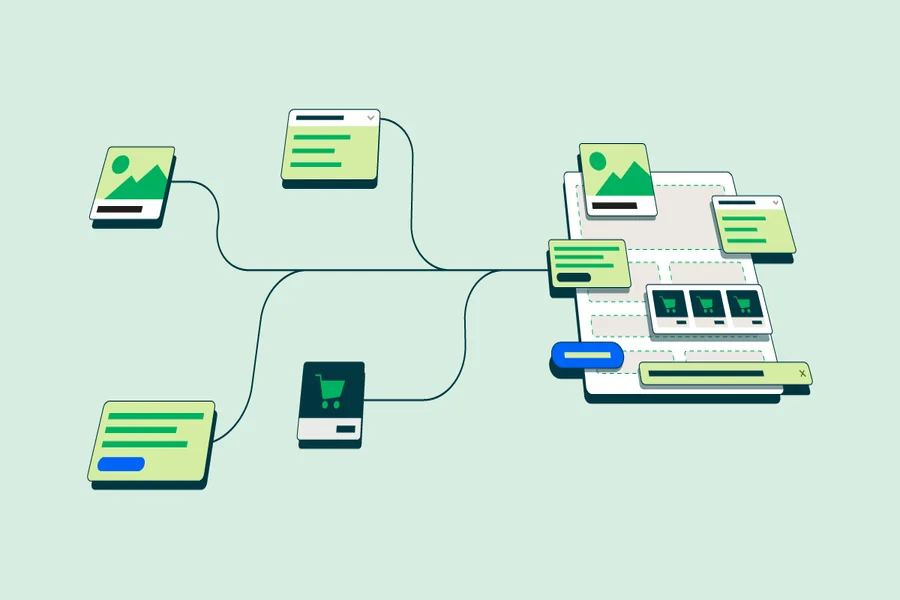
A headless CMS creates the right environment for automation because it stores content as structured data instead of locking it into one page layout or channel-specific template. In practical terms, this means content is broken into defined content types, fields, metadata, and relationships. A title exists as a title field, a summary exists as a summary field, and a product reference or audience label can be managed separately rather than being buried inside page text. This structure makes the content much easier for AI to interpret and act on.
That matters because automation depends on clarity. If content is inconsistent or tightly bound to one page design, AI has a much harder time helping in reliable ways. It may still generate suggestions or automate isolated tasks, but the workflow becomes fragile. In a headless CMS, by contrast, AI can work with more precision because it understands what each part of the content is supposed to represent. That allows it to classify, enrich, adapt, and distribute content more intelligently.
The headless model also improves flexibility. Content can be retrieved and reused across many channels through APIs, which means AI-driven workflow improvements are not limited to one frontend or one team. They can support the whole content ecosystem. This makes automation far more scalable and much more useful in real business operations.
AI Reduces Repetitive Work in Content Creation
One of the clearest benefits of AI in a headless CMS is the reduction of repetitive work during content creation. Teams often spend large amounts of time on tasks that are necessary but not especially strategic. This can include drafting first-pass summaries, generating headline options, rewriting the same message for different formats, preparing descriptions for metadata fields, or adapting one asset for another channel. These tasks take time, and when content volume is high, they can prevent teams from focusing on higher-value work such as positioning, storytelling, and quality improvement.
AI helps by accelerating these repeatable parts of the workflow. In a structured environment, it can suggest titles for specific fields, create summaries tailored to defined character limits, rewrite product copy for different tones, or generate variations suited to different delivery contexts. Because the content model is already clear, these suggestions can be much more targeted than in loosely structured systems. AI is not simply generating generic text. It is helping fill or improve specific parts of the content framework.
This makes the editorial process more efficient without removing human control. Teams still decide what should be published and how it should sound, but they spend less time on manual repetition. That can significantly improve speed and reduce the pressure that often builds up in high-volume publishing environments.
AI Strengthens Metadata, Tagging, and Classification Workflows
Metadata, tagging, and classification are essential to a healthy content system, but they are often among the most neglected parts of the workflow because they are repetitive and easy to postpone. When teams are under pressure to publish quickly, metadata may be incomplete, taxonomy may be applied inconsistently, and content may end up harder to find, measure, or personalize later. This creates long-term problems even if the publishing process feels fast in the moment.
AI is especially useful here because it can analyze structured content and support tagging and classification more consistently at scale. In a headless CMS, AI can look at titles, summaries, categories, body fields, and relationships to suggest metadata, recommend taxonomy terms, flag missing labels, or identify likely audience and journey-stage associations. This helps keep the content system cleaner without requiring every classification step to be done manually.
The business value of this is significant. Better tagging improves search, reporting, personalization, and reuse. It also reduces cleanup work later because the system stays more organized as content volume grows. In many cases, AI does not just save time here. It protects the long-term usefulness of the content environment by helping teams maintain stronger content hygiene while they scale.
AI Improves Editorial Review and Quality Control
Editorial review is one of the most important parts of a content workflow, but it can also become a bottleneck when volumes increase. Reviewers often need to check for consistency, tone, missing information, structural completeness, broken content relationships, duplicated assets, or formatting issues across large sets of content. This kind of work is important, but it can slow teams down when everything depends on manual review alone.
AI can help by acting as an additional quality-control layer before content reaches the final approval stage. In a headless CMS, it can review whether required fields are complete, flag inconsistencies in metadata, suggest improvements to readability, identify duplicate or overlapping content, or check whether a content entry appears to violate the intended schema. Because the content is structured clearly, AI can evaluate the asset at a more detailed level instead of only scanning a final rendered page.
This does not replace editorial judgment. Reviewers still need to evaluate message quality, business relevance, accuracy, and tone. But AI helps reduce the time spent on structural and repetitive checks. That makes the human review stage more focused and more strategic. Instead of spending energy on avoidable issues, teams can focus on refinement and quality, which improves both efficiency and outcomes.
AI Automates Content Reuse Across Channels
One of the biggest strengths of a headless CMS is content reuse, and AI makes that reuse more efficient. In traditional environments, teams often recreate similar content for different channels because adapting one asset manually for each platform feels easier than trying to extract it from a rigid page. This creates duplication and makes updates harder over time. In a headless system, content already exists as reusable components. AI helps by adapting those components more intelligently to different channels and contexts.
For example, one core content asset can be transformed into a shorter mobile-friendly version, an email summary, a support-oriented explanation, or a more promotional variation for a campaign. AI can assist with these transformations while preserving the meaning of the original content. Because the source material is structured clearly, the system can work from the right fields and maintain stronger consistency between the source and the variations.
This kind of automation reduces manual duplication and helps teams move faster when publishing across many channels. It also makes content updates more manageable because the organization is working from shared assets rather than from disconnected copies. Over time, this creates a much more sustainable omnichannel workflow where personalization and adaptation do not require constant rebuilding.
AI Helps Personalize Content Workflows and Delivery
AI does not only automate internal content tasks. It also improves how content is selected and delivered to users. In a headless CMS, personalization becomes easier because the content is modular and richly described through metadata and taxonomy. AI can use behavioral signals, audience context, and journey-stage patterns to decide which assets should be assembled or prioritized for a given user. This means content workflows no longer end at publication. They continue into live delivery and optimization.
This has two workflow effects. First, teams can prepare structured content assets that are meant for different intents and contexts, knowing AI can help deliver them more intelligently. Second, content operations become more connected to performance because AI-driven personalization creates clearer signals about which assets are helping users move forward. Teams can then use those signals to refine the content system further.
The result is a more adaptive content operation. Publishing is no longer only about placing content on a page. It becomes about maintaining a flexible set of content assets that AI can assemble into more relevant experiences in real time. That greatly increases the value of the content workflow itself.
AI Supports Better Workflow Prioritization Through Data
Content teams often struggle with prioritization. They need to decide what to update, what to create next, which assets are underperforming, and where gaps in the content ecosystem are creating friction. In many organizations, these decisions are still made using a mixture of instinct, limited reporting, and stakeholder urgency. AI can improve this by analyzing structured content data and helping teams identify where effort is most likely to matter.
In a headless CMS, this becomes much more practical because content assets are already modeled in ways that make comparison easier. AI can detect which content types consistently underperform, which topic clusters are growing in importance, where metadata suggests missing coverage, or which assets appear to be decaying in usefulness. It can also connect workflow patterns to outcomes, such as showing that certain update types consistently improve engagement or that certain categories of content generate repeated user friction.
This helps teams work more strategically. Instead of reacting to whatever request is loudest, they can prioritize based on stronger evidence. AI turns workflow planning into something more informed and less reactive, which is especially valuable in organizations where content demand always exceeds available time and resources.


