If you look at an aerial map of Sarasota, or drive through its newer subdivisions, you might notice a monotonous architectural trend. Almost every house looks like a flattened pyramid. You rarely see the classic “A-frame” style found in the Northeast or Midwest.
This isn’t just a stylistic choice by local architects who love geometry. It is a survival strategy dictated by the wind, and increasingly, by your insurance agent.
In the high-stakes world of Florida real estate, the shape of your roof is no longer just about curb appeal; it is a financial variable. The debate between the “Hip” roof and the “Gable” roof is essentially a debate between aerodynamics and wind resistance. Understanding the difference can be the deciding factor in whether your home survives a Category 4 hurricane—and whether you can afford to insure it.
The Aerodynamics of the Sail
To understand the insurance premiums, you have to understand the wind.
A Gable roof is the classic triangle. It has two sloping sides and two vertical walls (the gable ends) that extend up to the peak. It is easy to build, allows for great ventilation, and looks charming.
However, in a hurricane, the flat vertical wall of a Gable roof acts exactly like a sail.
When 140 mph winds hit that flat wall, the air has nowhere to go. It pushes hard against the structure (lateral pressure). Worse, as the wind whips over the peak of the triangle, it creates a massive vacuum on the backside (uplift). This combination of pushing and pulling can peel the roof deck right off the trusses. In severe cases, the gable end wall itself collapses, leading to catastrophic structural failure.
The Pyramid Advantage
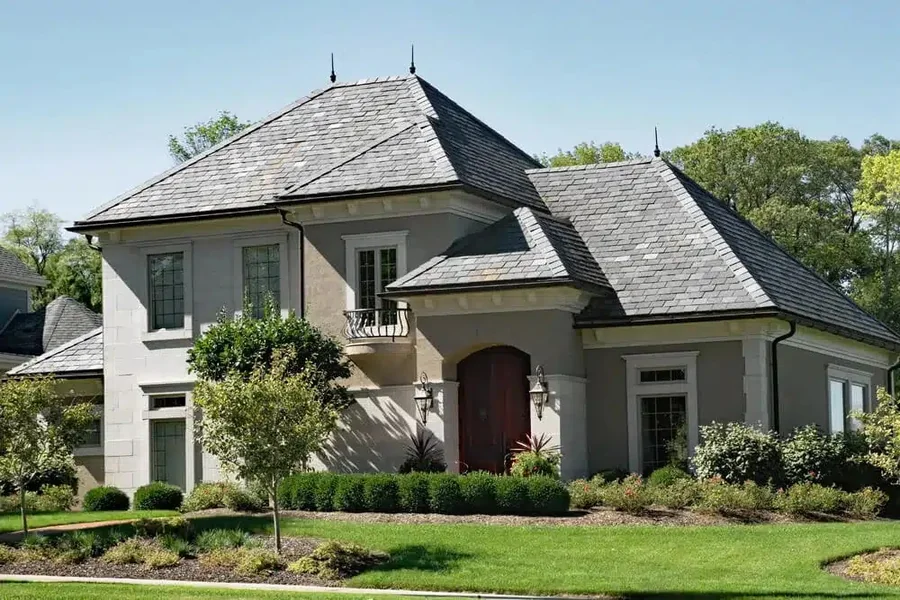
A Hip roof, by contrast, has no vertical walls. It slopes down on all four sides to meet the wall plate. It looks like a pyramid.
Aerodynamically, this is superior. When a hurricane hits a Hip roof, the wind doesn’t hit a wall; it hits a ramp. The air is forced up and over the house. This shape naturally deflects the wind, reducing the lateral load on the walls. Furthermore, because there are no sharp, flat ends to create turbulence, the uplift forces are significantly lower.
The Hip roof doesn’t fight the wind; it tricks it. It effectively makes the house “stealthy” to the storm.
The “Check Box” Worth Thousands
Insurance carriers are well aware of this physics lesson. In Florida, every homeowner is familiar with the “Wind Mitigation Inspection”—the golden ticket to lower premiums.
On this form, there is a specific section dedicated to “Roof Geometry.”
- If your roof is classified as “Hip” (meaning more than 90% of the roof perimeter is hip shape), you qualify for a significant discount.
- If your roof is classified as “Other” (which includes Gable), you get zero discount for geometry.
The financial difference is startling. For a standard single-family home in Sarasota, checking the “Hip” box can save homeowners anywhere from 20% to 40% on the wind portion of their insurance premium. Over ten years, that geometry alone can put $10,000 to $15,000 back in your pocket.
The Structural Trade-Off
If Hip roofs are so much better, why build Gables at all?
Gable roofs are cheaper to frame. They use less lumber and are simpler to construct. They also offer more attic space and better opportunities for windows and ventilation. A Hip roof is more complex to frame (requiring more cuts and specialized trusses), heavier, and offers less attic volume, which can make it harder to vent the heat out of the house.
However, in the post-Hurricane Ian landscape, the cost-benefit analysis has shifted permanently. The initial savings of framing a Gable roof are obliterated by a few years of higher insurance premiums.
Conclusion
For prospective homebuyers or those planning a custom build, looking up is just as important as looking around. A charming A-frame cottage might win on aesthetics, but it will lose on economics.
While you can retrofit clips and upgrade shingles, you cannot easily change the shape of your house. The geometry is the DNA of the structure. If you are unsure about the classification of your current roof or how to improve its wind rating, consulting with a specialized roofing company in Sarasota FL can clarify your wind mitigation report. They can help you identify if minor modifications could push your “Other” roof into a “Hip” classification, potentially turning a physics problem into a financial solution.